Your First Bushcraft Axe UK: The One That Won't Chop Your Leg Off
As an Amazon Associate we earn from qualifying purchases. This page contains affiliate links — if you buy through them, we earn a small commission at no extra cost to you.
Choosing your first bushcraft axe is a significant step, but it can be overwhelming. This guide simplifies the process, helping you select a reliable, safe axe suited for the British woodlands without guesswork. As a key part of our essential UK bushcraft kit list, it will equip you to make a confident and practical investment in your bushcraft journey. If you’re feeling ready to take that first step but want a handy reminder of the essentials, our free starter checklist is a great place to begin.
Why an Axe? Your First Bushcraft Companion
An axe is a cornerstone tool in bushcraft, offering unparalleled versatility and efficiency for processing wood in the wild. While your trusty bushcraft knife is brilliant for finer tasks and detail work, and we have a great guide to the best budget bushcraft knives, when it comes to breaking down larger pieces of timber for a fire, building a shelter, or even preparing materials for basic crafts, an axe really comes into its own. Many beginners try to do everything with a knife for too long. Getting a decent small axe is a massive help for campcraft — especially when building a quick shelter or getting reliable firewood. According to the British Museum, axes have been fundamental tools for humanity for millennia, with evidence of their use dating back to the Stone Age. This rich history underscores the primal connection we feel when wielding one, and why it’s such an important part of the bushcraft toolkit.
Think about it this way: trying to baton (that’s using another piece of wood to strike the spine of your knife) through a thick log to get to the dry heartwood is slow, hard work, and puts a lot of stress on your knife. An axe, with its weight and leverage, makes short work of that same task, saving you energy and preserving your knife’s edge. It’s not just about raw power, though; an axe allows for controlled cuts, splitting, and even basic shaping that would be incredibly laborious, if not impossible, with just a knife. For example, when making a simple lean-to shelter, a small axe lets you quickly fell small saplings (where permitted, of course!), trim branches, and even shape stakes for the structure. It’s about efficiency and capability.
What’s more, there’s a deeply satisfying, almost primal connection you feel when working with an axe. It’s one of the oldest tools known to humanity, and learning to wield it safely and effectively connects you to generations of outdoorsmen and craftspeople. It’s part of the whole bushcraft experience, giving you the ability to truly interact with your environment and create what you need. Of course, with that power comes responsibility – safety is vital, and we’ll look at that later. But for now, understand that choosing a good axe is less about choosing a tool, and more about choosing your primary partner for many woodland adventures. It’s a significant step, and a brilliant one, on your journey into bushcraft. If you’re wondering about the full rundown, you might find a comparison with knives helpful for understanding their different roles — you can find more thoughts on that in the main blog section.
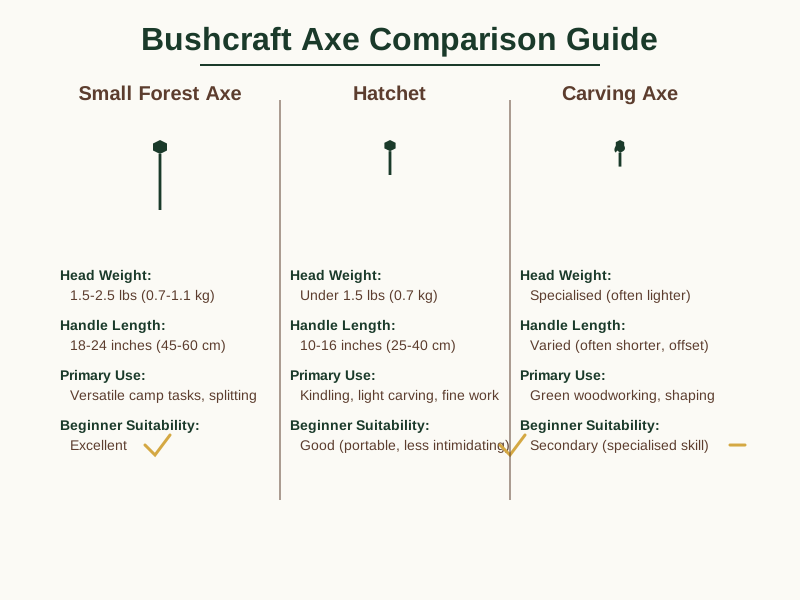
Bushcraft Axe Comparison Guide
| Type | Head Weight | Handle Length | Primary Use | Beginner Suitability |
|---|---|---|---|---|
| Small Forest Axe | 1.5-2.5 lbs (0.7-1.1 kg) | 18-24 inches (45-60 cm) | Versatile camp tasks, splitting | Excellent |
| Hatchet | Under 1.5 lbs (0.7 kg) | 10-16 inches (25-40 cm) | Kindling, light carving, fine work | Good (portable, less intimidating) |
| Carving Axe | Specialised (often lighter) | Varied (often shorter, offset) | Green woodworking, shaping | Secondary (specialised skill) |
Types of Axes: Not All Choppers Are Created Equal
Demystifying the various types of axes is crucial for a beginner, as understanding their specific functions prevents you from buying a tool ill-suited for bushcraft tasks. When you first start looking, you’ll see everything from massive felling axes designed for bringing down mature trees to tiny, almost toy-like hatchets. For bushcraft in the UK, especially when you’re just starting, we can narrow down the field significantly. We see beginners sometimes eyeing up massive felling axes. Brilliant tools, mind you, but absolutely overkill and frankly dangerous if you’re just starting out learning the ropes in a local wood. They’re designed for serious forestry work, not for processing firewood around a campfire or doing a bit of carving. The UK Forestry Commission (forestry.gov.uk) advises specific safety protocols for felling trees, highlighting that large felling axes are designed for professional use in managed woodlands, not casual bushcraft. If you ever get the chance to handle a friend’s axe or visit a bushcraft event, try a few sizes first. Feeling the weight and balance in your own hands makes the decision much easier.
So, what should you be looking for?
Small Forest Axes
These are often considered the sweet spot for bushcraft. They typically have a head weight between 1.5 to 2.5 lbs (around 0.7 to 1.1 kg) and a handle length usually ranging from 18 to 24 inches (45-60 cm). Their size makes them versatile — they’re capable of felling small trees (again, only where permitted and with proper training!), limbing branches, splitting small to medium-sized logs, and even some lighter carving tasks. They offer a good balance of power for processing wood and control for more nuanced work. If you’re planning on varied camp tasks, from fire prep to light shelter building, a small forest axe is likely your best bet.
Hatchets (or Small Belt Axes)
These are smaller and lighter than forest axes, with head weights often under 1.5 lbs (0.7 kg) and handles typically 10 to 16 inches (25-40 cm) long. Hatchets are excellent for very light wood processing, kindling preparation, and finer camp tasks where a larger axe might be cumbersome. They’re often carried on a belt (hence “belt axe”) for easy access. While they lack the power of a small forest axe for larger jobs, their portability and precision make them fantastic for specific tasks, and they can be less intimidating for a complete beginner. For example, if you’re primarily focused on small-scale carving, tinder preparation, or just need a lightweight option for shorter trips, a good hatchet is brilliant.
Carving Axes
These are a more specialised tool, often with a curved cutting edge and sometimes an offset handle to allow for better clearance when shaping wood. They are designed specifically for green woodworking, like making bowls, spoons, or other wooden items. While incredibly effective for their intended purpose, they’re not generally the best first axe for general bushcraft as they’re less versatile for heavy-duty wood processing. However, if you know you want to dive straight into carving, a small carving axe could be a fantastic secondary purchase down the line.
The key takeaway here is to match the axe to your intended use. Don’t buy a felling axe if you’re just going to be making kindling or carving a spoon. For most UK bushcraft beginners, a small forest axe provides the best all-around utility, offering enough power for common tasks without being overly heavy or unwieldy. A good hatchet is a close second, especially if portability is a major concern.
Key Features to Consider for Your First UK Axe
Choosing your first bushcraft axe involves looking at several key features that directly impact its performance, safety, and suitability for the varied conditions of the UK countryside. It’s about finding that sweet spot where the tool feels like an extension of your arm, rather than a clumsy weight. A beginner’s axe should balance power with control; look for a head weight between 1-2 lbs and a handle length of 14-20 inches for manageable use in varied UK conditions.
Let’s break down the critical elements:
Head Weight: This is perhaps the most important factor for a beginner. Too light an axe head and you’ll struggle to get enough momentum to cut efficiently, leading to more swings and increased fatigue. Too heavy, and it becomes unwieldy, tiring, and significantly more dangerous, especially when you’re still learning your technique. For a first bushcraft axe, we generally recommend a head weight in the 1 to 2.5 lbs (approx. 0.45 to 1.1 kg) range. This gives you enough heft for effective chopping and splitting of smaller logs, but remains manageable for control and precision. For example, a 1.5 lb head (around 680g) on a 16-inch handle is often a fantastic starting point for general camp tasks in British woodland.
Head Shape and Grind: While there’s a huge variety of axe head shapes out there, for general bushcraft, you’ll want something practical. A straight bit (the cutting edge) is very versatile for most tasks, from felling small saplings to splitting wood. Some axes have a slightly curved bit, which can be good for carving. Avoid overly specialised shapes, like those designed purely for competitive throwing or very specific carpentry, as they won’t serve you well for general bushcraft. The “grind” refers to how the steel tapers to the edge. A convex grind (where the sides curve outwards slightly before meeting the edge) is often preferred for bushcraft axes as it’s very strong and less prone to chipping when hitting knots or splitting tough wood. It bites deep but also helps wedge wood apart. Think of it like a subtle wedge that helps push the wood apart as it cuts, rather than just slicing through. This makes it brilliant for splitting.
Handle Material: The handle, or “haft,” is crucial for both comfort and shock absorption.
- Hickory: This is the traditional choice for a reason. Hickory wood is incredibly strong, flexible, and excellent at absorbing shock, which reduces strain on your hands and arms. It also offers a fantastic natural grip that improves with age and use. For a classic bushcraft feel and superior shock absorption, we’d always lean towards a good hickory handle. You can also easily sand and oil them to keep them in top condition. A study published by the Forest Products Society (forestprod.org) on wood properties consistently ranks hickory as having superior shock resistance and strength compared to many other timber species, making it ideal for tool handles.
- Fibreglass/Composite: These handles are incredibly durable, weather-resistant, and require very little maintenance. They won’t rot or crack in damp conditions like wood can, making them appealing for the UK’s often wet climate. However, they don’t absorb shock as well as hickory, which can lead to more vibration feedback, and some people find they lack the “feel” of a wooden handle. Brands like Fiskars often use composite handles, and they make very effective, no-nonsense axes. My advice? For a true bushcraft experience, go with hickory if you’re prepared to give it a little care. If you want something incredibly tough and low-maintenance, a good composite handle is a solid choice.
Handle Length: This directly influences the power and control you have over the axe. A longer handle generates more leverage and speed, leading to more powerful blows – great for felling, but harder to control for precise work. A shorter handle offers more control and is easier to manoeuvre in tight spaces, but with less power. For beginners, a manageable length is key. Handles that are too short offer little leverage, and ones that are too long can be hard to control when you’re learning. That 14-20 inch (35-50 cm) sweet spot is usually spot on for most UK woodland tasks, offering a good balance for chopping, splitting, and some finer work. For example, a Hultafors Ågelsjon axe (a popular small forest axe) typically comes with a 20-inch handle, which is brilliant for general use.
Blade Edge (Sharpness): You might think a sharp axe is more dangerous, but the truth is, a sharp axe is a safer axe. A keen edge bites deeply and cleanly into the wood, requiring less force and reducing the chance of the axe glancing off or bouncing back. A dull axe, on the other hand, is more likely to deflect, leading to uncontrolled swings and potential injury. While you’ll need to learn to maintain that edge yourself (something we’ll touch on later and which is crucial for safety), make sure your new axe comes with a decent factory edge. Don’t worry if it’s not razor-sharp; that’s something you can always improve. Getting into the habit of sharpening before each significant outing will make a huge difference, and you can find more guidance on that in our other articles. Don’t forget to check how the head is attached to the handle. On wooden handles, a well-seated head with a visible wooden wedge (and sometimes a metal one) means it’s properly secured. A loose head is incredibly dangerous, so always give it a quick wiggle check before use.
When considering these features, remember that the goal is a tool that feels balanced, controllable, and effective for your hands and your intended use. Don’t be swayed by marketing that promises “ultimate survival” features; focus on solid, traditional design principles adapted for modern bushcraft.
Top UK-Friendly Axe Brands & Where to Buy
Finding a quality bushcraft axe in the UK doesn’t have to be a wild goose chase; several reputable brands offer excellent options readily available through trusted retailers. This section aims to bridge that gap, giving you solid recommendations that are accessible and proven in British conditions. We generally recommend checking out places like Yeoman Outdoor or even having a look in larger camping stores. They often have a decent selection and you can get a feel for the weight and balance, which is crucial. If you have specific questions about brands, don’t hesitate to get in touch.
Here are some brands we’ve come to trust:
Hultafors: Hultafors is a Swedish brand known for producing high-quality, hand-forged axes at a more accessible price point than some of their premium competitors. Their “Classic” range, like the Ågelsjön (paid link) or Hultån, are fantastic small forest axes that are perfect for bushcraft. They feature hickory handles and durable steel heads, offering excellent value for money. They’re sturdy, hold an edge well, and are built to last. Many UK bushcrafters start with a Hultafors, and for good reason – they’re a superb entry into quality axes.
Fiskars: While perhaps not as “traditional” looking as Hultafors, Fiskars axes, with their composite handles and unique head designs, are incredibly effective, durable, and low-maintenance. Their X-series axes (like the X7 hatchet (paid link) or X10 forest axe (paid link)) are very popular in the UK due to their availability and performance. They’re virtually indestructible, don’t suffer from rust on the handle, and come with excellent sheaths. If you prioritise practicality, durability, and a no-fuss approach, a Fiskars axe is a brilliant choice, especially for the UK’s damp climate. According to their website, Fiskars UK (fiskars.com/en-gb/) details their patented blade grinding technique, explaining how it reduces friction and improves cutting efficiency for a sharper, cleaner cut, which is a real benefit for beginners.
Gränsfors Bruk: These are often considered the Rolls-Royce of bushcraft axes. Also Swedish, Gränsfors Bruk axes are individually hand-forged by skilled smiths, and each axe head is stamped with the smith’s initials. They are incredibly well-balanced, razor-sharp out of the box, and a joy to use. While they come with a higher price tag (often £150+), they are a lifetime investment. If your budget allows, a Gränsfors Small Forest Axe or Wildlife Hatchet is an heirloom-quality tool that performs beautifully. They’re aspirational for many, but definitely worth mentioning for their exceptional quality.
Other Options: You might find some smaller UK-based makers or re-sellers, but always do your research. Brands like Bahco also produce decent, affordable axes that can be good for beginners, though they might not have the same level of craftsmanship as the Swedish brands.
Where to Buy in the UK:
The good news is that these brands are well-supported in the UK.
- Specialist Outdoor Retailers: Websites like Yeoman Outdoor (yeomanoutdoor.co.uk), Woodlore (woodlore.co.uk – Ray Mears’ school shop, which often stocks high-quality tools), and The Bushcraft Store (thebushcraftstore.co.uk) are excellent places to start. They often have knowledgeable staff and a good range of bushcraft-specific axes.
- Larger Chain Stores: Stores like Go Outdoors and Millets sometimes stock Fiskars axes, which are a great accessible option. You might even find some basic axes in hardware stores, but always check the quality carefully.
- Online Marketplaces: While you can find axes on Amazon UK, be cautious. Stick to verified sellers and known brands. Avoid anything that looks like a “tactical survival axe” from an unknown manufacturer, as these are often poorly made and dangerous.
What to Avoid:
Steer clear of cheap, flimsy “survival” axes or novelty items you might see online or in discount stores. These are often made from poor-quality steel, have loose heads, or uncomfortable handles. They might seem like a bargain, but they’re a false economy and, more importantly, a safety risk. For a crucial tool like an axe, invest in quality from a reputable brand. Our advice is to read reviews, handle axes in person if you can, and trust your gut. A good axe should feel solid and balanced in your hand.
Safety First: Respecting Your Axe
An axe is a powerful and effective tool, but it demands respect and careful handling. Learning proper axe safety isn’t about being scared of the tool; it’s about being smart, aware, and ensuring you can enjoy your bushcraft adventures without incident. Honestly, the biggest mistakes we see beginners make are around safety — not clearing their space properly or carrying it carelessly. It’s not about being scared, it’s about being smart and respectful of the tool. The Royal Society for the Prevention of Accidents (RoSPA) (rospa.com) consistently stresses that proper training and understanding of tool limitations are crucial for preventing accidents with hand tools, including axes.
Here are the golden rules for safe axe use in the British woods:
The Golden Rule: Treat Your Axe with Respect: This isn’t just a saying; it’s a mindset. Always assume your axe is razor-sharp and capable of serious injury. Never swing it carelessly, leave it lying around unsheathed, or use it for tasks it wasn’t designed for. A well-maintained axe is a safer axe, so keep it sharp and clean.
Safe Carrying: When you’re moving around, your axe should always be sheathed. A good leather or Kydex sheath protects both the blade and, crucially, you and your gear. If you need to carry it unsheathed for a short distance (e.g., from your work area to a nearby log), carry it by the handle with the bit (blade) facing away from your body and slightly downwards. If you’re walking further, especially through dense undergrowth, it’s best to carry it in your pack, securely stowed and sheathed, or by hand with the handle over your shoulder and the head behind you, blade facing away. For safe axe handling in the UK woods requires constant awareness: maintain a stable stance, keep your surroundings clear, and always use a secure sheath when not actively chopping.
Clear Your Work Area (The “Arm’s Length Plus Axe” Rule): Before you even think about swinging your axe, clear a generous space around you. This means removing any loose branches, rocks, or other obstacles that could interfere with your swing or cause you to trip. A good rule of thumb is to hold your axe out straight, extend your arm, and then take a full swing. Everything within that radius needs to be clear of people, animals, and hazards. Remember to look up too – are there any overhead branches that could catch your swing?
Stable Stance and Controlled Swings: A stable, balanced stance is fundamental. Plant your feet firmly, slightly wider than shoulder-width apart, and be aware of your centre of gravity. When you swing, it should be a controlled, deliberate motion. Don’t over-swing or put all your power into it, especially when learning. Let the axe’s weight do the work. Aim for precision, not brute force. It’s better to take several accurate, controlled swings than one wild, powerful one.
Never Chop Towards Yourself: This might seem obvious, but it’s a mistake that can happen in a split second. Always position the wood (and yourself) so that if the axe glances off or passes through the wood, its trajectory is away from your body, particularly your legs and feet. For example, when splitting kindling on a chopping block, ensure your legs are well clear of the axe’s path.
Chopping Block: Use a sturdy chopping block or log to elevate your work. This not only makes chopping more comfortable and efficient but also prevents your axe from hitting the ground (and potentially dulling or damaging the edge) if you miss or cut through the wood.
Gloves (Optional but Recommended): While not strictly a safety rule, a good pair of leather gloves can protect your hands from splinters, blisters, and improve your grip, especially in wet conditions.
Learning to use an axe safely is an ongoing process. Start with simple tasks, focus on your technique, and always be mindful of your surroundings. If you’re keen to delve deeper into the specifics, a dedicated guide on axe safety essentials would be a brilliant next step. Practice makes perfect, and safe practice makes you a responsible bushcrafter.
Caring for Your Axe in the UK’s Damp Climate
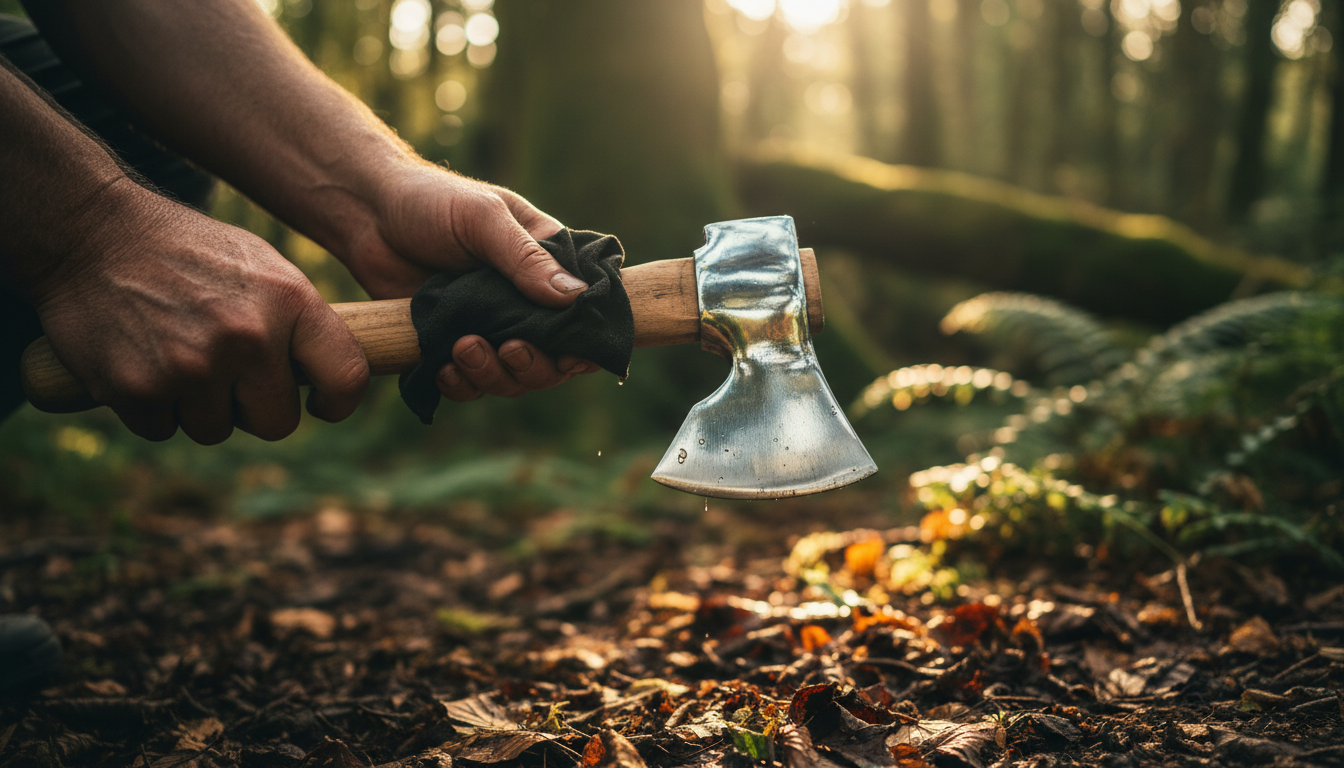
The UK’s climate, with its often damp, humid, and unpredictable weather, presents a unique challenge for axe owners: rust. Neglecting your axe in these conditions can quickly turn a beautiful, sharp tool into a rusty, pitted mess. This is where the UK really makes you pay attention. Axes can rust up faster than you might think possible just by leaving them in a damp tent overnight. A quick wipe down and a bit of oil makes all the difference. Proper care, tailored to our environment, is non-negotiable to protect your investment and ensure your axe serves you well for years. Combatting rust is really important for UK axe owners; regularly clean, dry, and oil the head, storing it in a dry environment to protect your investment from damp conditions. The Woodland Trust (woodlandtrust.org.uk) often highlights the importance of protecting wooden tools from moisture to prevent rot and fungal growth, which is particularly relevant in our damp climate.
Here’s how to keep your axe in prime condition:
Rust Prevention – The Primary Enemy: The steel head of your axe is highly susceptible to rust, especially after a damp day in the woods.
- Clean After Every Use: As soon as you’re done using your axe, take a moment to clean off any sap, dirt, or moisture. A stiff brush or an old rag works well. If there’s stubborn sap, a bit of white spirit or even cooking oil can help dissolve it.
- Dry Thoroughly: This is absolutely critical. Ensure the axe head is completely dry before storage. You can wipe it with a cloth, or if it’s really wet, let it air dry in a warm, dry place for a while.
- Apply a Light Coat of Oil: Once clean and dry, apply a thin layer of protective oil to the axe head. Linseed oil (especially boiled linseed oil), 3-in-1 oil, or even a basic cooking oil (like vegetable or olive oil) in a pinch will create a barrier against moisture. Just a few drops rubbed over the metal surface is enough. Do this every time you put your axe away after use, especially if you’ve been out in the rain or damp conditions.
Handle Care: Your wooden handle (if you have one) also needs attention.
- Check for Damage: Regularly inspect the handle for any cracks, splits, or looseness where the head meets the haft. Small cracks can be treated with linseed oil to prevent them from worsening. If the head feels loose, it might need re-seating – a task that might require professional help if you’re unsure.
- Keep it Dry: Wooden handles can swell and shrink with changes in moisture, which can lead to the head becoming loose. Try to keep your handle dry when not in use. Avoid leaving it submerged in water or lying on damp ground.
- Oil Your Handle: Periodically (every few months, or more often if it looks dry), rub some boiled linseed oil into the wooden handle. This nourishes the wood, helps prevent it from drying out and cracking, and enhances its grip. Taking care of your tools is a rewarding process, and you might even get into making your own DIY bushcraft gear.
Storage Matters: How and where you store your axe makes a massive difference.
- Dry Environment: Always store your axe in a dry place. A shed might seem like a good idea, but many sheds are prone to dampness. A garage or a dedicated spot indoors is usually better.
- Sheathed: Keep the sheath on to protect the edge and prevent accidental contact. However, if the sheath itself is damp, remove it and let both the axe and sheath dry separately before putting it back on. Never store a wet axe in a wet sheath.
- Avoid Extreme Temperature Fluctuations: Rapid changes in temperature and humidity can stress both the metal and the wood. Try to store your axe in a relatively stable environment.
Sharpening – A Safer Axe: A sharp axe is not only more efficient but also safer, as it’s less likely to glance off the wood. While we won’t go into full sharpening technique here, make it a habit to check your edge regularly. If it feels dull or struggles to bite, it’s time for a touch-up. Keeping it sharp is part of the maintenance routine, and you can find specific guidance in our other guides on axe maintenance for UK weather. Keeping a small oil rag in a sealed bag in your pack so you can wipe the head down before it goes back in the sheath, especially in wet weather, is a smart habit.
Remember, a little bit of care goes a long way. These simple steps will ensure your first bushcraft axe remains a reliable and cherished companion for many years of outdoor adventures.
Common Beginner Axe Mistakes (And How to Avoid Them)
Every seasoned bushcrafter has made a few blunders along the way, and that is nothing to be ashamed of. When you’re just starting out with an axe, it’s easy to fall into some common traps. The good news is that by being aware of them, you can easily sidestep these pitfalls and save yourself a bit of hassle, money, and maybe even a scraped knuckle or two. We will admit, most beginners make most of these when they start. The biggest one is probably thinking you need a massive axe straight away. That wastes money and makes everything harder.
Here are some of the most frequent beginner axe mistakes and how to avoid them:
Buying Too Big/Heavy an Axe: This is probably the most common mistake. Beginners often think “bigger is better” for power, but a large, heavy felling axe is simply too much for most bushcraft tasks and is significantly harder to control, especially for someone new to the tool.
- Avoid It: Stick to a small forest axe or a sturdy hatchet (1-2.5 lbs head weight, 14-20 inch handle) as recommended earlier. Focus on control and efficiency over raw power.
Not Buying (or Using) a Sheath: A sheath isn’t just an accessory; it’s a critical safety item. Leaving an axe unsheathed, whether in your pack, car, or camp, is incredibly dangerous.
- Avoid It: Always ensure your axe has a well-fitting, sturdy sheath. Use it every single time the axe isn’t actively in use.
Neglecting Maintenance (Leading to Rust/Damage): Especially in the UK’s damp climate, failing to clean, dry, and oil your axe head after use will quickly lead to rust and pitting, degrading its performance and lifespan.
- Avoid It: Make axe care a habit. A quick wipe and oil takes literally minutes but saves your tool. Store it dry, and regularly check the handle for any issues.
Using the Wrong Technique (e.g., Chopping Like an Axe-Thrower): Many beginners see axe-throwing on TV and think that’s how to chop wood. Wild, uncontrolled swings are inefficient and highly dangerous.
- Avoid It: Focus on controlled, deliberate swings. Let the axe’s weight do the work. Practice proper stance and aim for precision. Start with smaller pieces of wood and simpler tasks to build your technique and confidence.
Not Understanding the Wood Type You’re Working With: Trying to split a thick, knotty piece of green oak with a small hatchet is a recipe for frustration and potential damage to your tool.
- Avoid It: Learn about common UK wood types. Understand that green wood is harder to process than seasoned wood. Match your task to your tool and the wood’s characteristics. For very tough or knotty wood, consider alternative methods or simply choose easier pieces.
By being mindful of these common errors, you’ll be well on your way to becoming a confident and safe axe user. Bushcraft is all about learning, and admitting you’re a beginner is the first step to mastering these essential skills.
Related Reading
Best Budget Bushcraft Knives UK: Top Picks Under £50 for Beginners An axe is a powerful tool, but a knife is essential for finer work. Discover the best budget-friendly knives to complement your new axe.
DIY Bushcraft Gear Projects for Beginners UK: Craft Your Own Kit Feeling inspired? Learn how to make your own gear, from pouches to spoons, and develop your crafting skills further.
Sources & Further Reading
- British Museum: Highlights the historical significance and fundamental role of axes in human history.
- UK Forestry Commission: Provides guidance on safe forestry practices and tool use in managed woodlands.
- Royal Society for the Prevention of Accidents (RoSPA): Emphasises the importance of proper training and understanding for safe hand tool usage.
Note: This article covers general principles and tips. For advice specific to your situation, get in touch.
Frequently Asked Questions About Your First Bushcraft Axe
What’s the best axe for woodland crafts like spoon carving?
For dedicated carving work, a proper carving axe is the better tool because it gives you finer control and a blade shape suited to shaping green wood. If you are just starting, though, a good hatchet can handle simple shaping jobs well enough while you learn the basics. I would treat a carving axe as a later specialist purchase, not your first general bushcraft axe.
Do I really need a £100+ axe, or can I get a decent one cheaper?
No. Premium axes are excellent, but a well-made mid-range axe from a reputable brand is enough to learn on and use for years. I would focus on sound construction, sensible size, and good balance before thinking about premium pricing.
How often should I sharpen my axe?
There is no fixed schedule, because it depends on use and what you are cutting. I would check the edge before each proper outing and touch it up as soon as chopping starts to feel harder or less clean. Small, regular maintenance is easier than waiting until the edge is badly worn.
Can I use my axe in wet weather?
Yes, and in the UK you often will. The important part is the care afterwards: dry the head as soon as you can, add a light coat of oil, and never leave it wet in the sheath or pack. Damp storage does more harm than wet use.
What’s the difference between a hatchet and a small forest axe?
A hatchet is smaller, lighter, and usually better for light camp jobs and short trips. A small forest axe gives you more reach and more power, which makes it more useful for general wood processing. For most beginners who want one tool to do most things, I would lean towards the small forest axe.
Taking the Next Step
The aim is not to find a perfect axe on paper. It is to choose one sensible tool that fits your size, your tasks, and your level of experience, then learn to use and care for it properly.
If you want a simple checklist alongside the guide, our free Bushcraft Starter Checklist is there to help you review the essentials before you head out.
Got your axe? Keep it sharp and safe — grab the free Axe Safety & Maintenance Card to keep in your kit.