Teepee vs Log Cabin Fire Lay for Damp Ground UK
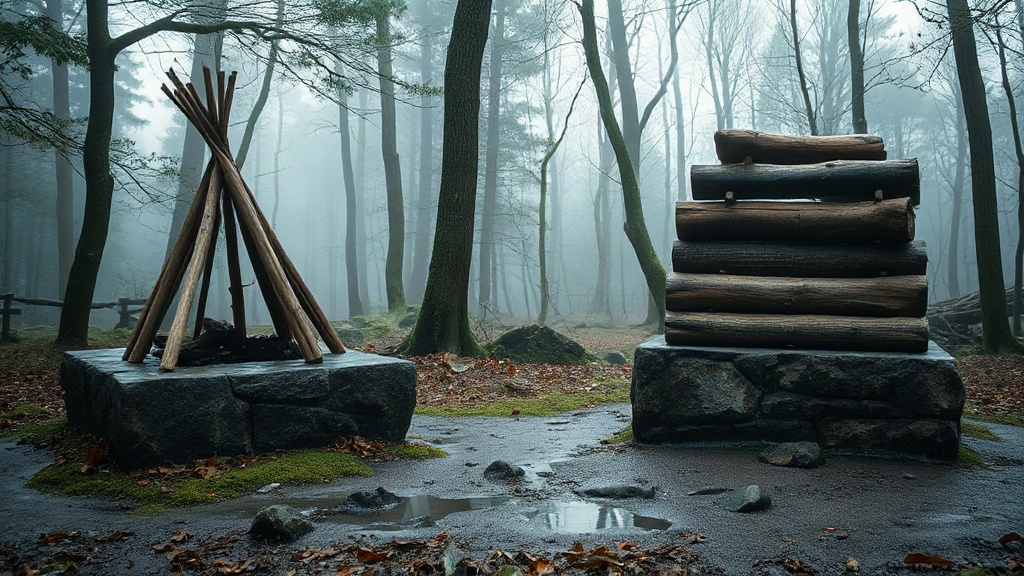
The defining difference between a teepee and a log cabin fire lay’s performance on damp ground is airflow direction relative to soil moisture. A teepee’s upward convection current pulls flames away from the wet base, while a log cabin’s structure traps ground moisture against its fuel.
When the ground is sodden, a fire loses heat to the soil faster than dry air can replace it. Soil moisture conducts warmth downwards, and the bottom layer of any fire lay will absorb this dampness through capillary action. This forces the fire to expend its initial heat driving off moisture instead of building flame. The convection current that should draw fresh air upwards fights against the ground’s pull downwards.
How ground contact disrupts fire
A fire built directly on wet earth faces a two-front battle. The cold air above and the damp soil below work together to steal the heat needed for ignition. Even dry-looking kindling placed on sodden ground will absorb moisture, leading to a fire that smoulders but never properly catches.
The chimney effect—the vital convection current that draws air in from below—is disrupted when the fire sits in a cold, damp pit. On dry ground this is barely noticeable, but on wet terrain it becomes the difference between success and failure.
Many beginners mistakenly blame their fire-starting tools when the real issue is ground contact. The pattern is familiar to experienced practitioners: a student tries different tinders and ignition methods without realising the fire is essentially sitting in an invisible puddle.
Why the teepee configuration succeeds
The teepee’s conical shape creates a strong upward convection current. Sticks leaned together at an angle form a cone with a gap at the base for air entry and a central chimney at the top for hot gases to escape. This geometry keeps the ignition point elevated above ground moisture.
As sparks ignite the tinder, the rising flames draw more air from below, feeding the fire faster than ground dampness can smother it. The teepee is self-correcting—the heat it generates protects it from the cold, wet base beneath.
It also lights faster than a log cabin on wet ground because it concentrates heat at the centre rather than distributing it across a wide base. A quick flame is already winning the battle against dampness.
The teepee does work best with a raised platform on truly wet ground. A few green logs laid parallel beneath the structure create a dry cavity that breaks direct contact with soil moisture. Hazel and birch, commonly found in British woodland, work well for this purpose.
Once established, the teepee burns hot and fast, making it less ideal for cooking than more stable configurations. But for initial ignition on damp ground, its airflow geometry makes it the superior choice. After the fire is going and the ground has dried, you can rearrange the logs for cooking.
Appropriate uses for the log cabin lay
The log cabin layout—logs stacked parallel on either side of a tinder bundle—creates a stable, long-burning fire that distributes heat evenly. Its square cross formation holds a pot steady, making it excellent for cooking where a sustained burn is needed.
📺 Watch: Fire Lays: which is better? Tee Pee Vs Log Cabin | The List
However, its fundamental weakness on wet ground is direct contact with the damp surface. The closed walls restrict airflow compared to the teepee, which helps in windy conditions but becomes a disadvantage when trying to start a fire on damp fuel. The moisture has nowhere to escape except into the wood.
A log cabin can work with dry kindling on wet ground, but it is risky. The closed structure traps ground moisture rising through the base, and bottom-layer kindling will absorb it even if the rest is dry. If committed to a log cabin, building a raised platform first is essential to remove this main failure mode.
On dry surfaces like sandy riverbeds or constructed fire mats, the log cabin excels. The stable base sits on dry ground, the parallel logs protect the tinder from wind, and the long burn time suits cooking or evening fires. The trade-off requires confidence about ground dryness before commitment.
A simple test: press your palm against the intended fire site for ten seconds. If it feels cold and damp, the ground is too wet for an unraised log cabin.
The critical role of a raised platform
Building a platform is the most effective adjustment for fire lays on wet ground, solving the problem before it exists. Green wood works best as it has high moisture content that doesn’t conduct heat like dry wood. The fire’s heat initially drives moisture from these logs rather than being conducted down into cold soil.
The logs create an insulating barrier and, once dried, add fuel from an unexpected angle. Even a modest elevation breaks direct ground contact and creates space for convection currents to establish properly.
If green wood isn’t available, stack dry stones for a raised base. A fire blanket or any dry flat surface can work. The principle is isolation from ground moisture rather than dependence on a specific material. Avoid using green wood already wet from rain or rotten wood lacking structural integrity.
For regular fire sites, carrying a small folding saw to cut green poles each visit provides lightweight, free insurance against ground dampness.
Both the fire lay and fuel quality are important, but the lay determines how wood interacts with the ground. The teepee protects dry fuel from ground moisture better due to its airflow geometry. Even excellent kindling fails if the lay’s base sits in a cold, wet puddle. Lay and fuel quality are sequential factors, not competing ones.
Comparing the approaches
| Feature | Teepee | Log Cabin |
|---|---|---|
| Airflow | Strong upward convection | Restricted, relies on gaps |
| Ignition speed | Faster, focused heat | Slower, distributed heat |
| Stability | Less stable once established | High stability for cooking |
| Ground contact | Needs raised platform | Direct contact with ground |
| Best use | Initial ignition on wet ground | Long burn on dry ground |

Deciding between a teepee and log cabin fire lay should happen before reaching your site, based on forecast ground conditions. The teepee’s upward airflow makes it the reliable choice for damp British woodland, particularly when combined with a simple raised platform. The log cabin remains ideal for dry ground where stable cooking and long burns are priorities.
This choice belongs in your pre-trip planning. Download the Free Bushcraft Starter Checklist for a lay-selection guide based on forecast conditions—a single page to keep in your pack.
Related Guidance
Our UK Firecraft: Choosing and Building Fire Lays for UK Woodland provides broader context on fire lay selection.
Sources & Further Reading
Note: General guidance only, verify details with a qualified professional or official source.