Fix a Fire in the Rain UK
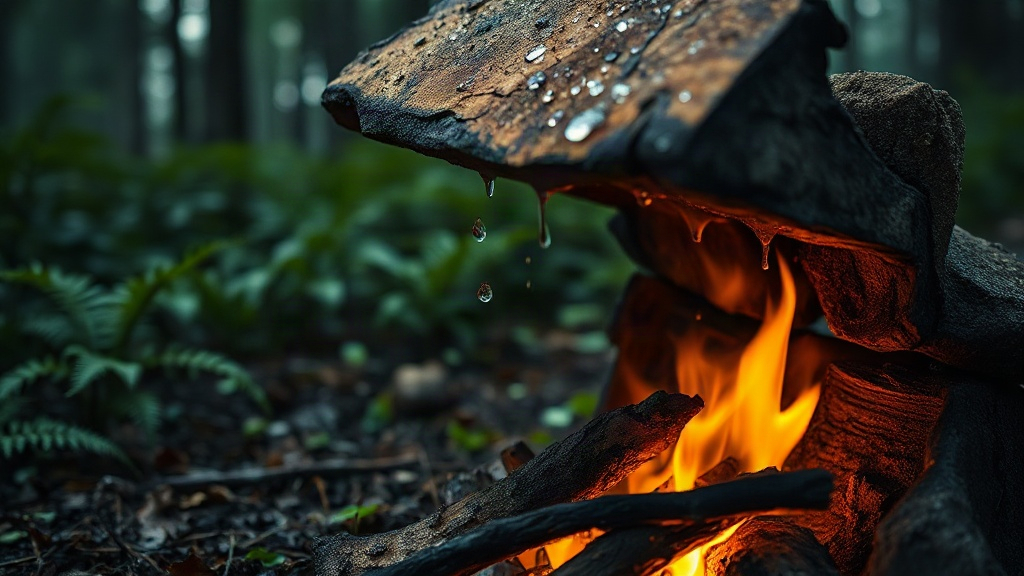
Upland England and Wales are among the wettest parts of the country. If you only practise fire lighting in dry conditions, you’re rehearsing for a minority of the days you’ll actually be outdoors.
It’s raining. Your fire is barely alive—wisps of smoke curling up from a coal bed that’s more charcoal sponge than glowing embers. The instinct is to grab more wood and throw it on. More fuel, more heat. That’ll sort it.
It won’t. Within two minutes the smoke thickens, the flames shrink, and the smell turns acrid. You’ve just made the problem worse.
The issue isn’t a lack of wood. Your fire is drowning, and throwing wet fuel at it is like trying to dry a towel by dropping it in a pool. The heat goes into boiling off water instead of burning cleanly, and the coal bed—the one asset you’ve built—cools below the temperature it needs to stay alive.
The fix for a dying fire in the rain is not more wood. It’s a roof.
The Physics of a Fire Fighting Rain
Damp wood doesn’t just fail to burn—it actively absorbs heat. The energy from your coal bed goes into driving moisture out of the fibres rather than releasing new heat through combustion. A log at 30% moisture content is roughly one-third water by weight. That water has to go somewhere, and the fire pays the bill.
📺 Watch: How I Start Fire in the Rain with Nothing but my Knife & Firesteel
Rain makes this worse in two ways. First, raindrops hitting the coal surface cool it directly, dropping the temperature below the point where combustion sustains itself. Second, the air immediately above the fire becomes saturated with moisture, which thickens the smoke and starves the flames of oxygen. More fuel, more moisture, more smoke, less heat. The fire contracts rather than expands.
The coal bed is the critical asset. It took time and good tinder to build, and it’s the only part of the fire that can dry out new fuel and bring it to ignition temperature. Killing the coal bed means starting again. In wet British woodland, starting again in the dark is a bad evening.
So when the rain picks up and the fire flattens, the answer is not more fuel. It is a shield.
Shield Placement and Materials
A rain shield is a physical barrier placed above the fire that deflects direct rainfall while allowing smoke and hot air to escape. You’re not enclosing the fire. You’re putting an umbrella over it.
The shield needs to sit roughly 30–40 cm above the top of the flames. Lower than that and you restrict airflow too much; higher and rain drops through. An angle that sheds water away from the fire without sealing it in is what you’re aiming for.
First, clear any wet wood that has been sitting on or around the fire. Set it to one side where it can start drying under the shield’s overhang. Second, check your coal bed. If it has ash on top, blow or brush it clear—the glowing embers underneath are what you’re protecting. Third, position your shield material.
What material? A 55-litre rucksack cover, a poncho, a piece of tarpaulin, or even a thick piece of bark laid on two crossed sticks will do the job. UK field instructors have used a trench coat draped over a stick for exactly this purpose—it’s low-tech and it works. The key requirement is enough rigidity to hold its shape and enough overhang to keep rain splashing back off the shield from landing in the fire.
Once the shield is in place, the fire is in a micro-climate. Rain doesn’t hit the coal bed directly. Air flows in from the sides. The shield absorbs some heat, yes, but the fire is no longer fighting the weather as well as burning fuel. The coal bed stays hot, the wood you cleared to one side begins drying under the overhang, and within a few minutes the fire has stabilised enough that you can feed the now-drier kindling back in.
If you need a fire for campfire meals, keeping that coal bed alive under a rain shield means you’re not starting from cold every time you want to cook. That’s the practical payoff.
Essential Gear for Wet Conditions
A rain shield buys you time. The right fire-lighting kit means you can actually take advantage of it.
For wet conditions, there are three tools worth knowing about, and they work best as a system rather than in isolation.
Stormproof matches are the simplest option for getting a fire going in rain. They burn long enough to transfer a flame to damp tinder without the wind snuffing them the way it does a lighter. The Lifesystems Stormproof Waterproof and Windproof Matches (paid link) are known for their reliability. The trade-off is quantity: each pack contains a limited number, so they’re a backup rather than a primary source of ignition for extended trips.
View Lifesystems Stormproof Waterproof and Windproof Matches on Amazon → (paid link)
A ferro rod throws an extremely hot spark and isn’t bothered by wind or light rain. The Light My Fire FireSteel Army, Rusty Orange (paid link) is a popular model. The learning curve is real though, and it works best when you already have dry tinder prepared—which is exactly what the rain shield gives you. The 3/8-inch Ferro Rod Fire Starter Kit (paid link) is a compact and functional budget option.
Check 3/8-inch Ferro Rod Fire Starter Kit price → (paid link)
A bellows is the piece of wet-fire kit that beginners often overlook. Blowing directly on a coal bed by mouth puts you close to the smoke and any sparks, and it’s easy to extinguish embers rather than fan them. A pocket bellows like the Spitfire Pocket Bellows (paid link) gives you control and distance.
Buy Spitfire Pocket Bellows on Amazon → (paid link)
The sensible approach for wet conditions: stormproof matches for initial ignition, dry tinder from a tin, a ferro rod as a backup, and a bellows to nurture the coal bed while the shield keeps the rain off.
Assessing and Sourcing Wood
A rain shield protects the fire in the moment. Good fuel practice protects you over a whole weekend.
Wet wood makes you burn water as much as wood—the fire spends heat on evaporation instead of heat output. How long wood has been sitting around is a rough guide at best; split a piece and check the heart instead.
The practical test is to tap two logs together. A hollow, resonant sound indicates the cell structure has dried out. A dull thud means moisture is still holding.
For a course or camp where you’re collecting on-site, look for dead standing wood rather than fallen logs. Wood that hasn’t been in contact with damp ground often dries better. Birch bark is widely recognised as excellent tinder even in damp conditions.
A roofed log store is genuinely worth having if you’re burning wood regularly. The crucial point is airflow: a fully sealed store can trap moisture and re-wet wood over a wet British winter. The wood needs to stay dry from rain but breathe to release the moisture it’s already holding.
Comparing Rain Shield Options
| Material | Pros | Cons |
|---|---|---|
| Rucksack Cover | Lightweight, easy to pack | May not hold shape well in wind |
| Poncho | Waterproof, flexible | Can be bulky to store |
| Tarpaulin | Rigid, large coverage | Heavy, harder to transport |
| Bark on Sticks | Natural, free | Limited size, less durable |
| Trench Coat | Durable, flexible | Unconventional, may smell |
Common Questions Answered
Can I use green wood in the rain?
Green wood is high in moisture regardless of the weather and won’t burn well in any conditions. It produces excessive smoke, few coals, and more tar than heat. Save it for the fire that’s established and burning cleanly—and even then, only once you have seasoned fuel running through it.
What if I don’t have a tarp or poncho?
Large pieces of bark laid across two crossed sticks, a waterproof jacket held on a stick, or even a heap of green branches stacked loosely over the fire can work as a temporary shield. The priority is deflecting direct rainfall from the coal bed. An improvised shield is better than no shield at all.
What’s the best fire starter for rain?
Stormproof matches or a ferro rod are generally more dependable than a standard lighter in damp or windy conditions. A lighter works well indoors or in shelter, but can struggle outdoors.
Turning Knowledge into Action
The fire is the asset. The wood is the fuel. Your job is to protect the asset first and feed it second.
A rain shield above the coal bed is the missing step that most beginners skip. Once the shield is up and the coal bed is protected from direct rainfall, the fire self-regulates—it dries out the fuel around it and stays alive long enough for you to bring in properly dried kindling. The instinct to add more wet wood is understandable, but it’s exactly backwards. Stop adding fuel, build a shield, then feed the fire with wood that has dried out under its own overhang.
If you’re heading out on a course or a weekend camp and you want a clear list of what to take and how to prepare before you light anything, we’ve put together a free checklist that covers the essentials without the gear-shop pressure. Grab it here: Download the Free Bushcraft Starter Checklist .
Getting a fire going in the rain separates theoretical knowledge from practised skill. Use this checklist as your wet-weather rehearsal plan to run through at home before your next outing.
Related Guides
Our guide on UK Firecraft: Troubleshooting a Fire That Won’t Stay Lit provides more detailed troubleshooting steps.
Sources & Further Reading
As an Amazon Associate we earn from qualifying purchases. The products linked above are ones we think are worth a look.
Note: General guidance only, verify details with a qualified professional or official source.