Why Your Fire Goes Out After Lighting
As an Amazon Associate we earn from qualifying purchases. Some links on this page are affiliate links, which means we may earn a small commission if you make a purchase.
I watched a fire of mine catch perfectly from a single strike, the birch bark curling into a clean flame. I added a handful of twigs, expecting it to roar to life. Instead, it faded to smoke within thirty seconds. The coal still glowed, but the flame was gone. What had I starved it of in those first moments?
That experience stayed with me. Getting the initial light right only to lose it moments later feels like a personal failure. The frustration is sharp because the solution is counter-intuitive: you must wait when everything tells you to act.
This article explains what happens in those critical seconds after ignition and how to break the cycle of a fire that dies young.
Diagnosing a Fading Flame
Before focusing on timing, let’s rule out other common failures. A fire can die for several reasons beyond just adding fuel too early.
📺 Watch: Gas Logs: Flame Won’t Stay On - Why?
Fuel that isn’t dry enough. This is the usual suspect. Wood that feels dry can still hold enough moisture to cool the fire, causing it to smoulder rather than burn. In UK conditions, properly seasoned fuel isn’t a luxury—it’s a necessity.
Restricted airflow. A fire needs oxygen to breathe. Building a fire lay that’s too dense or sheltering it excessively can starve the flame. The classic error is stacking kindling so tightly that the coal underneath gets no air.
Rushing the process. This is the mistake most beginners make without realising. The instinct to feed the newborn flame is strong, but piling on material too soon seals it off. The flame uses up the available oxygen in its immediate space and suffocates.
Your equipment is rarely the real problem. People often blame a high-end ferro rod while using damp tinder and adding fuel prematurely. The rod works fine; the technique needs adjustment.
Before you strike, ask two questions: does your fuel snap cleanly rather than bend? And have you left enough space around your fire lay for air to circulate?
Understanding the Fragile First Minute
Here’s the physics at play when a fire is born.
A flame is a chemical reaction that needs fuel, heat, and oxygen in a continuous cycle. The oxygen cycle is especially fragile at the beginning. A new flame on tinder needs a moment to draw fresh air across each layer of fuel.
When you light a tinder bundle, you create a small, hot flame in a confined space. It rapidly consumes the oxygen within that bundle and the air immediately surrounding it. The flame converts oxygen into heat, which then ignites more fuel. This process is delicate. Adding material on top before the coal has stabilised acts like placing a lid on a candle, blocking the oxygen supply.
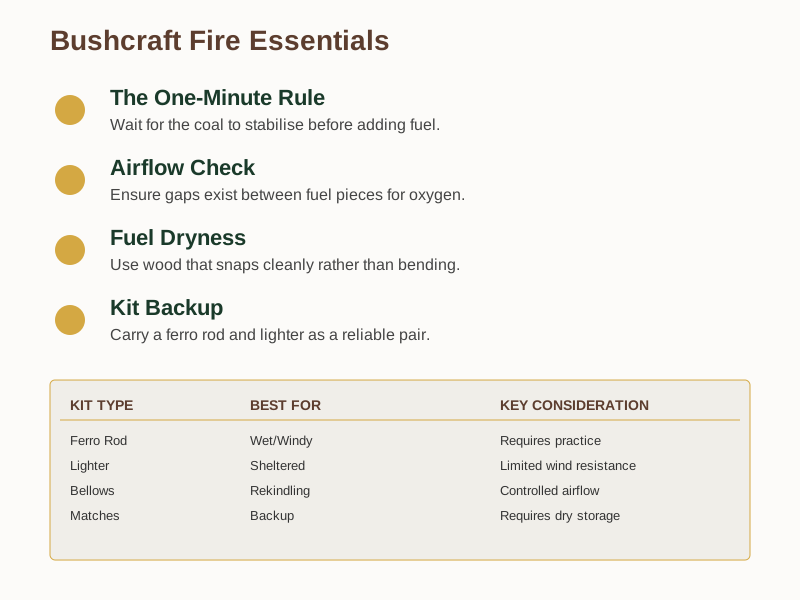
The glowing coal at the heart of the tinder needs time to reach a temperature where it can accept new fuel without being extinguished. A good rule of thumb is to wait at least a full minute before adding any significant kindling. Not a few seconds—a full sixty seconds.
Think of a candle flame: bright and self-sustaining. Cover it with a jar and it dies. Your tinder bundle before that minute is up is the jar. Adding fuel is putting the lid on before the flame has established itself.
Once the coal is stable—appearing bright orange and steady—you can begin adding fuel gradually. Start with small pieces, leaving gaps for air to reach the core. You’re feeding a reaction, not constructing a building.
Patience, not better gear, is the secret to a sustaining fire.
Fire Lighting Equipment That Helps
If technique is key, why discuss kit? Because the right tools make correct technique easier to execute, especially when you’re cold or your hands aren’t steady.
Ferro rods are a bushcraft standard. The Light My Fire FireSteel Army, Rusty Orange (paid link) is a robust option known for producing a strong spark. It has a learning curve but is reliable with practice. The Army version is often preferred for its size over the Scout model.
See Light My Fire FireSteel Army, Rusty Orange on Amazon → (paid link)
A basic 3/8-inch ferro rod kit serves well as a compact backup, functional without being refined.
Lighters offer a quick start. A 6 x Mini BIC Lighter Set is inexpensive and reliable in calm conditions, though its usefulness drops in wind. For a beginner, carrying a ferro rod with a lighter as backup covers most scenarios.
Tinder is where technique meets material. Exotac quickLIGHT Tinder Tabs (paid link) are easy to ignite. Spartan Fire Tinder, White 6 Pack (paid link) is compact but can be slower to catch. A simple Waterproof Match Case, Metal Airtight (paid link) with dry matches and foraged birch bark often works just as well without extra cost.
Buy Exotac quickLIGHT Tinder Tabs on Amazon → (paid link)
Bellows can assist with airflow. The Spitfire Pocket Bellows (paid link) allows you to direct air without getting your face close to sparks. It’s particularly useful for gently reviving a fading coal rather than starting a large fire.
Check Spitfire Pocket Bellows price → (paid link)
Adjusting to the UK Seasons
Your approach to tinder and fuel should shift with the British seasons.
During autumn and winter, dead birch bark is a commonly used natural tinder. It can often be found on standing dead trees and is valued for its flammability. Fallen conifer needles and dried bracken also work. This season is generally easier as fuel tends to be drier.
In spring and summer, conditions are trickier. New growth is green, and ground-level debris is often damp from rain or dew. Birch bark remains useful, but you might need to split it to find dry inner layers. Look for dry grass in sheltered areas. A good strategy in wet weather is to gather standing deadwood rather than material from the ground.
When it’s raining, your fire lay becomes crucial. A teepee structure on a raised, dry base gives the flame a frame and protection. A Dakota fire hole, with its underground air shaft, offers excellent protection from wind and rain but requires more effort to build.
Storing wood properly makes a significant difference. A simple, roofed store keeps fuel dry and seasoned, turning green wood into usable fuel over time.
Common Problems and Their Solutions
Why does my fire go out even with dry wood?
The issue is likely airflow. If wood is piled too high or too tightly before the coal is stable, the flame suffocates. Use a shallower lay and increase the waiting time between adding fuel.
Ferro rod or lighter: which is better?
Each has its place. Ferro rods excel in wet or windy conditions and don’t run out. Lighters are quicker and easier in shelter. The practical approach is to carry both, using the rod as your primary tool.
How can I tell if wood is dry enough?
Check for cracks in the end grain, a light colour, and a hollow sound when tapped. A rough field test is to see if a thin stick snaps cleanly rather than bends.
Fire Lighting Kit Comparison
| Kit Type | Best For | Key Consideration |
|---|---|---|
| Ferro Rod | Wet/Windy Conditions | Requires practice and dry tinder |
| Lighter | Sheltered Conditions | Limited wind resistance |
| Tinder Tabs | Ease of Ignition | Higher cost per use |
| Bellows | Controlled Airflow | Best for rekindling coal |
| Matches | Backup Option | Requires dry storage |
| Birch Bark | Natural Tinder | Seasonal availability |
| Pocket Bellows | Smoke-Free Airflow | Not for starting large fires |
Mastering the First Minute
The solution to a dying fire isn’t usually a new purchase. It’s adopting the one-minute rule: let the coal stabilise before adding fuel. Airflow, dry tinder, and a sensible fire lay all support this critical timing.
If your fire keeps failing, ask not “what kit do I need?” but “what did I add, and when?”.
A fire that breathes stays lit. That’s the core of it.
For a quick pre-session reminder covering fuel, technique, and kit, our Free Bushcraft Starter Checklist has you covered. Download it here: Download the Free Bushcraft Starter Checklist .
Deeper Reading
For more detailed troubleshooting, see UK Firecraft: Troubleshooting a Fire That Won’t Stay Lit .
Sources & Further Reading
As an Amazon Associate we earn from qualifying purchases. The products linked above are ones we think are worth a look.
Note: General guidance only, verify details with a qualified professional or official source.