Ferro Rod Technique for Wet Hands
As an Amazon Associate we earn from qualifying purchases. Some links on this page are affiliate links, which means we may earn a small commission if you make a purchase.
The standard instruction for a ferro rod is to hold the rod steady and push the striker down its length. With wet hands, invert this: pin the striker against the rod and pull the rod back towards you. This keeps the angle consistent and directs sparks onto the tinder when your grip is compromised.
Moisture is the most common reason a ferro rod fails in British woodland. This isn’t a gear problem. It’s a technique problem. Once you understand why a wet hand makes the striker slide, the correction is immediate.
The Physics of a Wet Grip
A ferro rod works by shaving off tiny particles of ferrocerium that ignite on contact with air. That requires friction—a sharp, controlled scrape. When your hands are wet, the striker glides instead of bites, producing a weak scatter of sparks or nothing at all.
Beginners often react by trying harder. Longer strokes, more aggression, a white-knuckle grip that reduces precision. The real fix is simpler: address the moisture.
Performance is consistent across quality rods like the Light My Fire FireSteel Army, Rusty Orange (paid link) and 3/8-inch Ferro Rod Fire Starter Kit (paid link) when technique is correct. The issue sits between the striker and the rod.
View 3/8-inch Ferro Rod Fire Starter Kit on Amazon → (paid link)
Dry Hand, Reliable Spark
Most guides overlook a critical step: drying your striker hand before each scrape, not after you’ve failed.
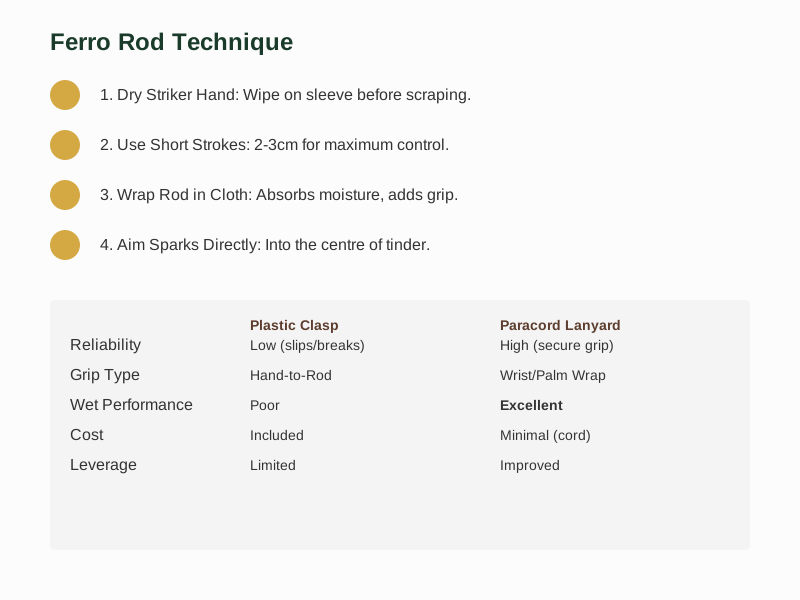
Wet skin on metal has substantially lower friction. The striker skips across the rod instead of shaving it. The solution is simple. Before each scrape, wipe your striker hand on a dry surface—a jacket sleeve, a cloth, the inside of your shirt. One wipe removes the surface moisture killing your friction.
Wrapping the ferro rod in a dry cloth provides a secondary advantage: the cloth absorbs moisture from the rod and gives a textured grip that wet hands can’t get on bare metal. A small piece of cotton rag in your fire kit solves both problems.
Improving Your Rod’s Setup
The hand-drying technique solves the friction problem, but your gear choices can help or hinder. A paracord lanyard is superior to a plastic clasp setup, offering higher reliability, an excellent grip in wet conditions, and improved leverage. Plastic clasps can slip or break under stress or moisture. Remove the plastic clasp and replace it with a loop of paracord. This gives you a lanyard to wrap around your wrist or grip directly, remaining secure with wet, cold, or gloved hands.
📺 Watch: 6 Helpful Ferro Rod Techniques - Bushcraft / Survival 101
A paracord lanyard also allows you to hold the rod and striker with one hand, which is useful when your other hand is managing tinder. The longer cord provides better leverage for a controlled scrape.
A 3/8″ diameter ferrocerium rod throws a denser shower of sparks than thinner alternatives, which helps with damp tinder. Simple rods without storage capsules or gimmicks perform more consistently.
Executing the Technique
With dry hands and sorted gear, the technique is direct.
Dry your striker hand on a cloth or jacket before every scrape. Keep your tinder in a sealed bag or tin—wet tinder won’t take a spark. Hold the rod with the lanyard wrapped around your wrist, and the striker in your dominant hand with a firm but controlled grip.
Use short, controlled strokes of 2–3cm, not long sweeps. Long strokes increase the chance of the striker sliding off. Aim sparks directly into your tinder bundle. A focused spray will catch within a few attempts if everything else is right.
Blow gently once sparks land. A hard blow extinguishes the ember. Let the heat build.
What Typically Goes Wrong
A few recurring errors and their solutions.
Using a wet knife as a striker is common. A dull or wet blade won’t bite. Use a dedicated striker or a dry cloth wrapped around the blade spine.
Blowing too hard on the tinder is another mistake. A sharp breath is enough; a lungful will kill the ember. Owners of the Light My Fire FireSteel Army, Rusty Orange (paid link) report it works best with the right tinder and a gentle approach.
See Light My Fire FireSteel Army, Rusty Orange on Amazon → (paid link)
Relying on a thin rod in poor conditions is a third issue. A 3/8″ diameter makes a real difference to spark density.
Questions and Quick Answers
Can I use a lighter with wet hands?
Yes, but lighters fail in heavy rain or with a soaked flint wheel. A ferro rod is more reliable because the sparking mechanism doesn’t depend on a dry flint wheel—and with the dry-hand technique, you can use it effectively even with wet hands.
What if I have no dry cloth?
Use a dry corner of your jacket, a piece of dry bark, or your sleeve. Any dry material that absorbs surface moisture will restore enough friction. In an emergency, dry your hand on your thigh through a dry trouser leg.
Is a special striker necessary?
Not strictly. A dedicated striker with a hardened surface works better than a wet knife, but the main advantage is consistency. A dry cloth wrapped around a knife spine can substitute, but a hardened striker is better for a proper kit.
Building Reliable Muscle Memory
The ferro rod is one of the most dependable fire-starting tools you can carry. It’s weatherproof and works when other methods fail—provided the technique is sound. Wet hands are the variable most people miss.
Technique degrades under cold and stress, so this checklist is the muscle-memory drill sheet to run before conditions deteriorate, not after. Sound kit choices matter: a paracord lanyard instead of plastic clasps, a decent diameter rod, dry tinder in a sealed container. This doesn’t require expensive gear, just knowing what to do when the weather turns.
If you’re assembling a fire kit or reviewing your current setup, get the free checklist . It outlines what you genuinely need for British woodland.
Related Guides
Our guide on UK Firecraft: Mastering Fire Lighting Tools for Damp Conditions covers complementary tools.
References
As an Amazon Associate we earn from qualifying purchases. The products linked above are ones we think are worth a look.
Note: General guidance only, verify details with a qualified professional or official source.